
Southern Calamari Angling Masterclass & Overview
Southern Calamari (Sepioteuthis australis) represent Australia’s premier cephalopod sport fishery, driving the rapidly expanding Japanese-style ‘Eging’ discipline across southern coastal waters. Inhabiting clean inshore bays, marine meadows, and rocky headlands, calamari demand specialized technical tackle, refined sink-rate management, and sharp rod manipulation. Balancing lightweight 8-foot egi rods with micro-diameter braided lines is essential for achieving maximum casting distance and feeling subtle tentacle taps on the drop.
Calamari are visual apex predators possessing large, highly evolved eyes that detect polarized light, UV reflection, and contrasting silhouettes against the surface. Anglers must fish with micro-diameter PE 0.5 to PE 0.8 braided lines connected to 6lb to 10lb 100% Japanese fluorocarbon leaders. Fluorocarbon’s higher specific gravity (~1.78 SG vs ~1.14 for nylon mono) eliminates line belly and sink resistance, allowing the squid jig’s built-in keel weight to maintain its intended 45-degree horizontal fall angle rather than pulling it nose-up or dragging it flat.
Land-based jetty, pier, and rock fishing revolves around long-distance casting over broken ground and shallow Posidonia seagrass meadows in 2 to 6 metres of water. Long 8 foot 3 inch to 8 foot 6 inch parabolic egi rods allow fishos to execute sharp, double-handed vertical whips that make the jig dart violently side-to-side before entering a stable horizontal glide. Calamari strike almost exclusively during the horizontal falling phase as the jig settles toward the weed canopy.
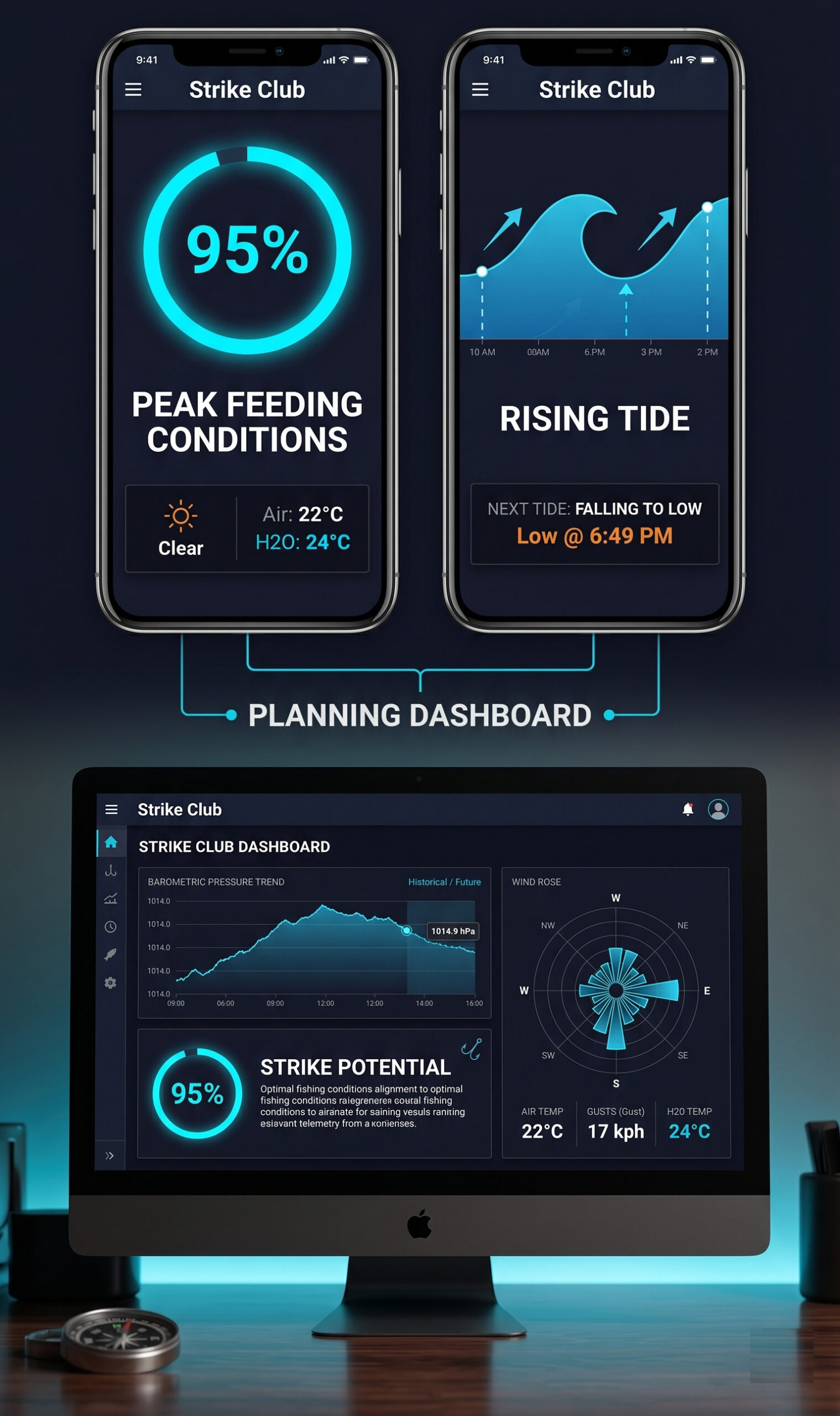
Boat and kayak fishos utilize drifting tactics across 3 to 15-metre depth contours, employing weighted Tip-Run jigs or clip-on chin sinkers to combat strong tidal currents. Anchoring up-current of sand patches nestled inside dense kelp lines and deploying trailing baited squid spikes under a float produces consistent bag limits during tide changes. Calm, high-barometer autumn and winter days with gin-clear water provide the most productive bite windows of the year.
| Best Rods | Best Reels | Squid Jigs (Egi) |
| Deep / Trolling | Tip-Run & Boat | Lines & Rigs |
Australian Southern Calamari Locations & Seasonal Distribution
| Region | Primary Habitat | Hotspots | Peak Season |
|---|---|---|---|
| 1. South Australia (Gulfs & Coast) | Posidonia Grass & Limestone Reef | Kangaroo Island, Port Lincoln, Edithburgh, Rapid Bay | March – October (Winter Monster Run) |
| 2. Victoria (Port Phillip / Western Port) | Shallow Reefs, Jetties & Tide Channels | Sorrento, Queenscliff, Flinders Pier, Mornington | Year-Round (Spring & Autumn Peaks) |
| 3. Western Australia (South-West) | Coastal Inshore Reefs & Sound Meadows | Cockburn Sound, Geographe Bay, Albany, Esperance | April – November |
| 4. Tasmania (East & North Coasts) | Sheltered Bays & Kelp Beds | Great Oyster Bay, Coles Bay, Tamar River, Stanley | November – April (Spawning Closures Apply) |
| 5. NSW Central & South Coast | Harbour Kelp Lines & Ocean Rock Platforms | Sydney Harbour, Jervis Bay, Botany Bay, Eden | May – November (Winter Clear-Water Run) |
| 6. South East Queensland (Moreton Bay) | Inshore Islands, Reefs & Weed Flats | Moreton Bay, Gold Coast Seaway, Pumicestone Passage | May – September (Predominantly Northern/Tiger Squid Sepioteuthis lessoniana) |
State Regulations, Bag Limits & Seasonal Closures (2026)
| State / Territory | Size Limit | Daily Bag Limit | Boat Limit & Closures |
|---|---|---|---|
| South Australia (Open Waters) | No Minimum Size | 12 Southern Calamari | Boat limit: 36 (3+ fishers). Applies strictly to open coastal waters (e.g. West Coast) |
| South Australia (Closed Gulf Waters) | No Minimum Size | 0 (Closed Zone) | Total closure in place (targeting, taking, and possession prohibited in Spencer Gulf, Gulf St Vincent, and Kangaroo Island zones) |
| Victoria (VFA) | No Minimum Size | 10 Combined Total | Applies per person per 24 hours statewide for combined squid, calamari, octopus, and cuttlefish. Possession limit: 10 |
| New South Wales (NSW DPIRD) | No Minimum Size | 20 Combined Squid | Possession limit: 20 combined squid and cuttlefish across all tidal waters |
| Queensland (Fisheries QLD) | No Minimum Size | 50 Combined (20 Tiger Squid) | Possession limit of 50 combined squid and cuttlefish (Max 20 Tiger Squid / Broad Squid) in all tidal waters |
| Western Australia (DPIRD) | No Minimum Size | 15 per fisher | Boat limit: 30. Governed under mixed nearshore finfish/invertebrate rules |
| Tasmania (Fisheries Tas) | No Minimum Size | 10 Southern Calamari | Possession: 20. Closed 1 Sept – 31 Oct (North Coast: Cape Grim to Cape Naturaliste) & 15 Oct – 14 Nov (South East: Lemon Rock to Whale Head) |
Southern Calamari Fishing Techniques by Environment
1. Shallow Seagrass Flats & Reef Edges (1.5m to 4m): Target lush Posidonia and Amphibolis weed meadows on high tide. Cast size 2.5 to 3.0 Shallow or Basic jigs across clear sand patches between the weed beds. Execute two gentle upward rod whips, then allow the jig to glide slowly downward on a semi-slack line right above the weed canopy.
2. Jetties, Piers & Lighted Structures (Night Eging): Public jetties and marina lights attract immense schools of baitfish and garfish after sunset. Cast size 3.0 or 3.5 Glow or UV-reactive jigs along the shadow line cast by overhead lights. Allow the jig to sink through mid-water before imparting a sharp, single vertical whip and a long 6-second pause.
3. Deep Boat Drifting & Tip-Run Eging (5m to 15m): Position the vessel up-wind and drift along broken reef drop-offs. Deploy heavy 30g to 40g Tip-Run jigs or attach a clip-on nose weight to standard 3.5 jigs to overcome strong tidal flow. Hold the rod horizontal with tension to detect subtle forward line movements as calamari grab the jig.
4. Ocean Rocks & Heavy Whitewater Wash: Fish deep rocky points and ocean washes on calm swell days. Cast size 3.5 Deep or heavy keeled jigs into current seams where whitewash meets green water. Heavy jigs cut through turbulent surface surge, maintaining a stable horizontal sinking angle that triggers large ocean calamari.
Egi Hydrodynamics, Sink Rates & Vision Science
Sink Rate Selection Physics: Matching jig sink speed to water depth is the fundamental rule of Eging. Standard Basic jigs sink at 3.0 to 3.5 sec/m, Shallow jigs sink at 5.5 to 6.0 sec/m, and Deep jigs sink at 1.9 to 2.2 sec/m. Over shallow 2-metre weed flats, a standard jig sinks too rapidly and bogs in weed, whereas a Shallow-rated jig stays suspended in the visual strike zone three times longer.
UV & 490 Glow Contrast Spectra: Calamari eyes are highly sensitive to light wavelengths centered at 490nm (blue-green light), which penetrates deepest in saltwater. In low light or discolored water, jigs with 490 Glow or Keimura (UV-reactive) under-foils emit a distinct silhouette that squid identify from long distances. In bright sunny conditions over sand, natural gold, rainbow, and clear foils produce the highest conversion rates.
Low-Inertia Drag & Hooking Mechanics: Squid have delicate, fleshy tentacles that tear easily under heavy resistance. Set your spinning reel drag to an ultra-light 500g to 800g setting so that the reel emits a crisp zzz-zzz click on aggressive rod whips. When a calamari strikes, never strike aggressively—simply lift the rod smoothly and maintain continuous winding pressure to keep the barbless crown hooks pinned.