Fishing Cabbage Tree Point
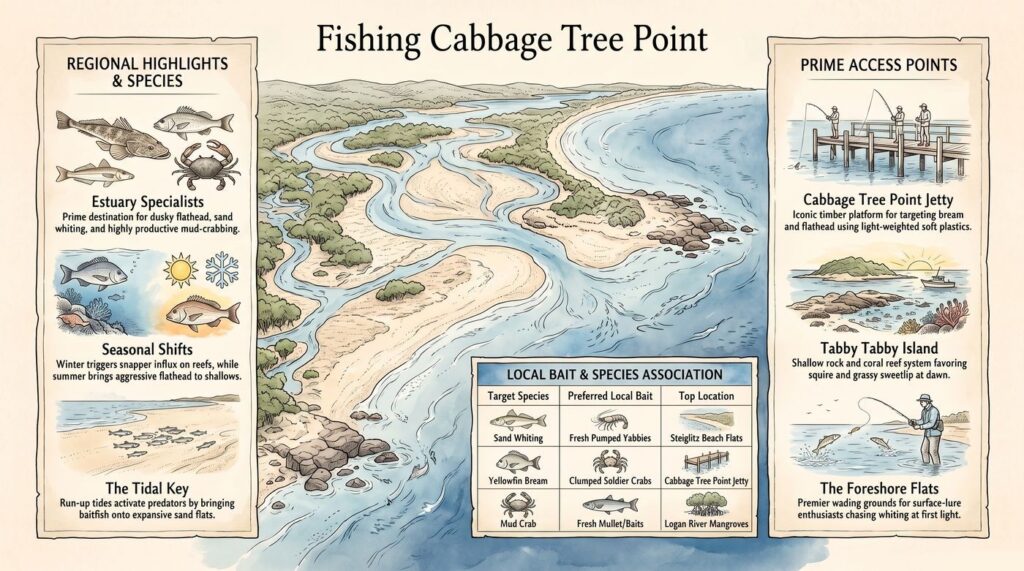
The local fishery is highly dynamic, dictated by the massive tidal exchanges running between the Logan River to the north and the Jumpinpin channels to the east. Seasonal transitions are highly pronounced, with winter triggering outstanding runs of yellowfin bream and flathead, while the warmer summer months bring explosive mangrove jack and threadfin salmon action into the muddy river channels. Understanding how to fish the tide transitions is essential, as the fast-flowing water forces baitfish and prawns out of the mangroves into the deeper channels where predators wait.
Land-based anglers are well catered for with sandy beach wading, rocky points, and public structures around Charlie Hammel Park. Wading the shallow sandbars on a rising tide with light spinning gear is a highly effective way to intercept feeding schools of sand whiting. Anglers must exercise extreme caution when wading close to the deep-water drop-offs, as the muddy substrate can be unstable and the tidal currents run exceptionally fast.
For boaters and kayak anglers, the maze of mangrove-lined islands like Stingaree and Kangaroo Islands provides endless sheltered options. Navigating these shallow channels requires a high-quality fishfinder and local knowledge, as extensive mudflats completely dry out at low water. The deeper channels hold outstanding sportfish, making this a highly versatile destination for trolling deep-diving hardbodies or casting soft vibes.
Top 10 Species
Landbased
- Charlie Hammel Park Beach: Cast light running sinker rigs with fresh yabbies into the shallow current gutters. Retrieve with a slow, continuous twitch to target sand whiting feeding along the sand transitions. Focus your casts during the first two hours of the rising tide when clean water enters.
- General Store Jetty: Cast fresh mullet strips parallel to the wooden piles on a rising night tide to target bream. Let the current wash the bait naturally through the structure without using heavy weights. Run a twelve-pound fluorocarbon leader to survive the sharp barnacle-encrusted timber.
- Cabbage Tree Point Wall: Slow-roll three-inch soft plastic paddle tails parallel to the rock transitions during the last of the run-out tide. Let the jig head bump the bottom to kick up visual puffs of silt. Focus your casts around the isolated weed clumps where dusky flathead wait.
- Southern Sandy Ledge: Present live yabbies on light running sinker rigs along the shallow sandy ripple zones. Retrieve with a slow, continuous twitch to target sand whiting feeding along the sandy drop-offs. Focus your casts during the first two hours of the run-in tide.
- Boat Ramp Pontoon: Cast small soft plastics on quarter-ounce jig heads parallel to the pontoon shadow lines. Work the lure with a fast, erratic hopping retrieve to trigger aggressive strikes from giant trevally. Target the twilight periods of dawn and dusk when baitfish concentrate.
Offshore
- Logan River Mouth: Position your boat up-current of the deep muddy channels and use a GPS-lock motor to hover. Deploy live poddy mullet on heavy running sinker rigs using a size four-zero circle hook. Target the brief thirty-minute window of slack water high tide for threadfin salmon.
- Little Rocky Point Reef: Drift the low-lying gravel patches casting seven-inch soft plastics on one-ounce jig heads. Work the plastic with a slow lift and drop retrieve close to the bottom to target snapper. Use side-imaging to locate active bait schools holding along the reef edges.
- Stingaree Island Gutters: Troll deep-diving hardbody minnow lures parallel to the mangrove-lined channel edges at three knots. Select lures that dive to three meters to bounce along the muddy bottom transition. This is a highly effective tactic for targeting active summer flathead.
- Southern Bay Gutter: Set up a slow drift with the wind, dragging live yabbies close to the bottom sandy transition. Keep your reel in free-spool with your finger on the line to detect flathead taps. Run a twenty-pound fluorocarbon leader to withstand the raspy teeth of trophy flathead.
- Powerlines Gutter: Anchor your vessel just outside the main current run and cast weighted squid baits down-current. Use a heavy pyramid sinker to keep the bait pinned securely along the muddy channel floor. Focus your fishing during the twilight periods of dawn and dusk.
Hot Spots
- Charlie Hammel Park Beach: Sandy beach and shallow flats offering outstanding wading access for sand whiting on a rising tide.
- Logan River Mouth: Deep muddy river channels holding threadfin salmon and schooling Mulloway.
- Stingaree Island Gutters: Highly productive mangrove-lined channels prime for crabbing and flathead trolling.
- The Powerlines Gutter: Deep current-funnel channel holding big Mulloway, flathead, and large estuary cod.
- Little Rocky Point Reef: Rocky and gravel patch reef holding snapper, grass sweetlip, and heavy yellowfin bream.
Local Bait Tips
- Yabbies: Pumped using a stainless steel yabby pump on the sand flats near the park foreshore at low tide. Hook them through the tail and up the body for whiting.
- Mud Crabs: Caught using heavy-duty round crab pots baited with fresh oily mullet carcasses in deep mangrove creeks. Check your pots every tide cycle, ensuring they are placed deep enough to avoid exposure at low water.
- Poddy Mullet: Cast-netted in the shallow margins of the Logan River creeks on a rising tide. Keep these hardy live baits in an aerated tank and fish them unweighted along the mangrove edges.
Boat Ramps
- Cabbage Tree Boat Ramp:
Cabbage Tree Boat Ramp: Located at Cabbage Tree Point Road in Steiglitz, this three-lane concrete ramp is very open to weather and choppy with a strong tidal side current. Features include a sandy beach, 18 CTU spaces, dedicated trailer parking for 30 vehicles, wide maneuvering zone, and no concrete walkway.
Bait and Tackle
- GEM BAIT & TACKLE: 281 Stapylton Jacobs Well Road, Stapylton QLD 4207 | Phone: (07) 3287 3868
- ORMEAU TACKLE & OUTDOORS: Peachey Rd, Ormeau QLD 4208 | Phone: (07) 5549 1233
Emergency & Safety
- Marine Rescue Jacobs Well: 1161 Pimpama-Jacobs Well Rd, Jacobs Well QLD 4208 | Radio: VHF 16, 73 | Phone: (07) 5546 1100