Fishing Coolangatta
Tidal flows are extremely strong through the river mouth, pushing clean oceanic water past Greenmount Point and flooding the expansive sand flats and mangrove channels upstream. Seasonal shifts bring a diverse range of target species, with winter welcoming outstanding spawning runs of yellowfin bream, tailor, and schooling Mulloway, while summer triggers explosive mangrove jack, giant trevally, and Spanish mackerel action. Flathead and sand whiting remain highly consistent year-round residents, shifting their feeding positions along the shallow drop-offs in response to the changing lunar cycles.
Land-based anglers are incredibly well catered for with extensive parklands, boardwalks, and public fishing platforms along Kirra and Greenmount. Wading the shallow flats surrounding Jack Evans Boat Harbour on a falling tide is a highly productive way to target trophy whiting and flathead on light tackle. Anglers must exercise extreme caution when wading near the main river channels, as deep drop-offs and fast-flowing currents can easily sweep a footing away.
For boat and kayak anglers, the deep current lanes, bridge pylons, and rocky revetment walls provide endless tactical options. Navigating the canal entrances and current seams requires a high-quality fishfinder to locate the baitfish schools pushed up against the stone structures. The deep-water junctions drop to over fifteen meters, holding schooling Mulloway that feed aggressively during the brief slack water high tide window.
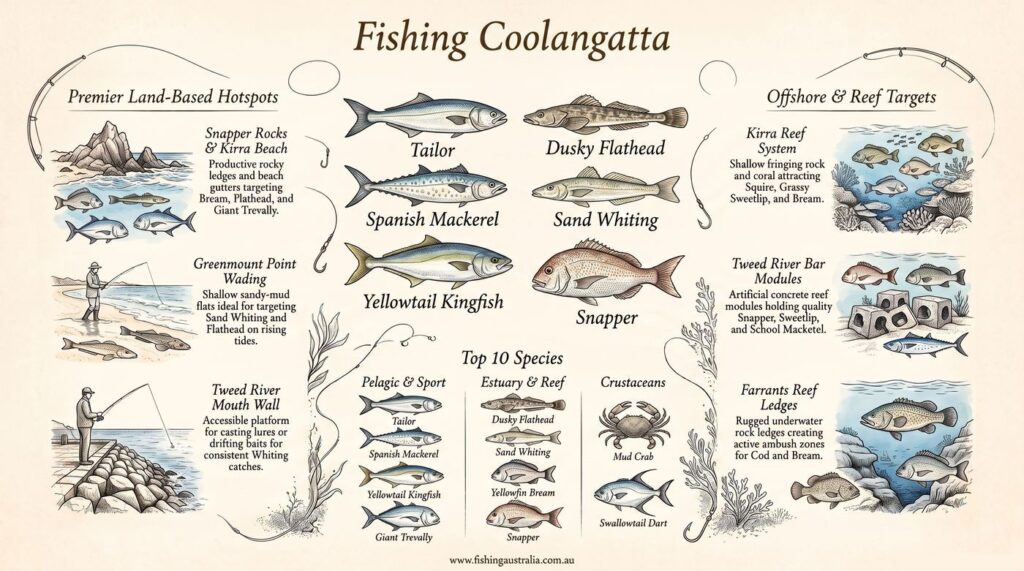
Top 10 Species
Landbased
- Snapper Rocks Ledges: Cast sixty-gram chrome metal spoons directly into the main current wash on a rising tide. Retrieve with a high-speed burn to target tailor. Let the lure sink for three seconds before cranking to target active yellowtail kingfish strikes in the deep pressure waves.
- Kirra Beach Gutter: Wading the sandy beach gutters running directly adjacent to the Kirra rock wall on a rising tide is highly visual. Cast fresh yabbies on ultra-light fluorocarbon leaders directly into the shallow ripples to target active sand whiting. Walk slowly to avoid spooking active schools.
- Greenmount Point Wall: Slow-roll three-inch soft plastic paddle tails parallel to the rock transitions during the last of the run-out tide. Let the jig head bump the bottom to kick up visual puffs of silt. Focus your casts around the isolated weed clumps where flathead wait.
- Jack Evans Shoreline: Wading the protected sandy beach area directly surrounding this coastal harbour is a premier land-based wading zone. Wade quietly along the shallow flats on a rising tide, casting live yabbies on ultra-light fluorocarbon leaders. Focus on the small sand ridges where baitfish gather.
- Tweed River Wall: Cast heavy-gauge soft plastics on half-ounce jig heads into the deep sand transitions near the southern training wall. Work the plastic with a slow lift and drop retrieve close to the rock walls. Focus your casts during the last two hours of the run-out tide.
Offshore
- Fido Reef Patches: Drift the low-lying gravel patches in thirty meters of water casting seven-inch soft plastics on one-ounce jig heads. Work the plastic with a slow lift and drop retrieve close to the bottom to target snapper. Use side-imaging to locate active bait schools holding along the reef edges.
- Tweed River Bar: Position your boat up-current of the deep ocean wash and drift unweighted live slimy mackerel on snelled rigs. Keep your reel in free-spool with your thumb on the line to allow the bait to swim. This is the premier offshore tactic for targeting Mulloway.
- Tweed River Canyon: Drift this deep channel using live herring close to the bottom sandy transition. Target active dusky flathead feeding along the edge of the shallow sand channels. Keep your boat positioned carefully to avoid grounding on the shallow sandbars.
- Kirra Reef Structure: Anchor your vessel just outside the main current run and cast weighted squid baits down-current. Use a heavy pyramid sinker to keep the bait pinned securely along the muddy channel floor. Focus your fishing during the winter months for snapper.
- Tweed West Branch: Position your boat up-current of the deep ten-meter junction and use a GPS-lock motor to hover. Deploy live poddy mullet on heavy running sinker rigs using a size four-zero circle hook. Target the brief thirty-minute window of slack water high tide.
Hot Spots
- Snapper Rocks Ledges: World-famous rock platform offering land-based casting access to heavy-tackle sportfishers.
- Kirra Beach Gutter: Sandy beach gutters holding active sand whiting and flathead on a rising tide.
- Greenmount Point Wall: Rocky wall creating localized current eddies, prime flathead ambush zone.
- Tweed River Deep Canyon: Deep sandy canyon holding quality Mulloway and flathead.
- Jack Evans Harbour: Protected sandy beach area, premier land-based wading zone for whiting.
Local Bait Tips
- Yabbies: Pumped using a stainless steel yabby pump on the extensive sand flats near Jack Evans Boat Harbour at low tide. Hook them through the tail and up the body for whiting.
- Poddy Mullet: Cast-netted in the shallow, mangrove-lined flats of the upper Tweed River branches on a rising tide. Keep these hardy live baits in an aerated tank and fish them unweighted along the mangrove edges.
- Live Herring: Cast-netted around the vertical concrete structures near the bridge pylons on high tide. Pin them through the nose to keep them swimming naturally in the current.
Boat Ramps
- Tweed Heads Kennedy Drive Boat Ramp:
Tweed Heads Kennedy Drive Boat Ramp: Located on Kennedy Drive in Tweed Heads, this high-capacity multi-lane concrete ramp features a central floating pontoon, abundant trailer parking, and direct all-tide deepwater access to the lower reaches of the Tweed River.
Bait and Tackle
- BURLEIGH HEADS BAIT & TACKLE: Gold Coast Hwy, Burleigh Heads QLD 4220 | Phone: (07) 5535 4422
Basecamp & Accom
- The Sebel Twin Towns Coolangatta: 14 Griffith St, Coolangatta QLD 4225 | Phone: (07) 5536 2111
Emergency & Safety
- Marine Rescue Point Danger: Captain Cook Memorial Lighthouse, Top of Boundary St, Coolangatta QLD 4225 | Radio: VHF 16, 67 | Phone: (07) 5506 5900