Fishing North Stradbroke Island
Tidal flows are exceptionally powerful around the point, with strong ocean currents generating massive pressure eddies on the down-current side of the basalt rocks. Seasonal shifts are highly pronounced, with winter welcoming outstanding spawning runs of yellowfin bream, tailor, and surf Mulloway, while summer sees the arrival of giant trevally, queenfish, and Spanish mackerel. Understanding how to read the beach gutters is critical, as fish will shift their positions constantly to follow the baitfish schools.
Land-based anglers can target this pristine wilderness system by driving the sand tracks and fishing the beach gutters on foot. Wading the shallow surf gutters on a rising tide yields outstanding sand whiting and flathead on light spinning gear. Wading anglers must exercise extreme caution, as the rock platforms are highly exposed to massive ocean swells.
For boat and kayak anglers, launching from the nearby river mouth provides direct access to the close-lying offshore reefs and headland wash. Navigating the headland zone requires a high degree of skill and constant vigilance to avoid rolling your vessel in the breaking swell. The ultimate prize lies in fishing the deep-water current lanes surrounding the eastern ledges, which hold world-class sportfish.
Top 10 Species
Landbased
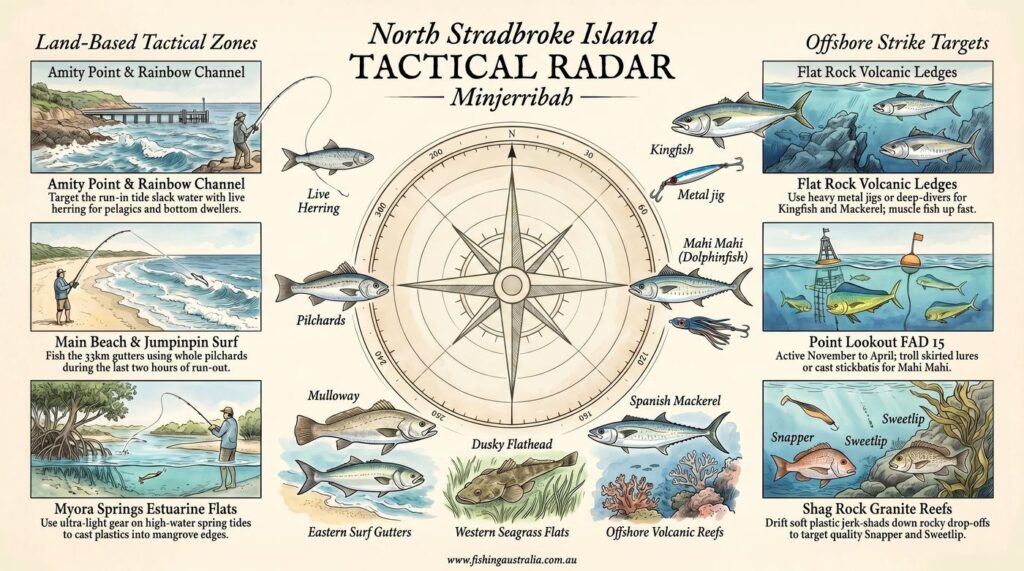
- Amity Point Jetty: Cast unweighted live yabbies on a size four long-shank hook directly into the fast-flowing current lanes. Retrieve with a slow, continuous twitch to target sand whiting feeding along the deep sandy drop-offs. Use a three-kilogram fluorocarbon leader to maximize your bite rate in the clear water.
- Dunwich One Mile Flats: Wading the sandy mudflats on an incoming tide is highly productive. Slow-roll three-inch soft plastic paddle tails on light five-gram jig heads to trigger flathead strikes. Let the lure occasionally bump the bottom to kick up visual puffs of silt.
- Point Lookout Rocks: Cast sixty-gram chrome metal spoons directly into the main current seam on the eastern edge during a rising tide. Retrieve with an aggressive high-speed burn to trigger active tailor feeding in the surf. Let the lure sink for three seconds before cranking.
- Main Beach Beach Gutters: Fan-cast whole pilchards on ganged three-zero hooks directly into the dark blue ocean beach gutters at high tide. Slowly retrieve the bait to keep it moving naturally through the surf wash where migrating tailor feed. Use a running slider rig.
- Cylinder Beach Shallows: Fan-cast small surface walking lures across the shallow weed beds on a rising tide. Work the lure with a fast dog-walking retrieve to trigger surface strikes from sand whiting. Walk slowly to avoid spooking active feeding schools.
Offshore
- South Passage Bar: Drift the deep current seams on high tide slack water using live slimy mackerel on snelled rigs. Keep your reel in free-spool with your thumb on the spool to allow the bait to swim naturally. This is the premier offshore tactic for Mulloway.
- Amity Point Gutter: Position your boat up-current of the deep muddy channels and use a GPS-lock motor to hover. Deploy live poddy mullet on heavy running sinker rigs using a size four-zero circle hook. Target the brief thirty-minute window of slack water.
- Flat Rock Reefs: Drift the low-lying gravel patches in thirty meters of water casting seven-inch soft plastics on one-ounce jig heads. Work the plastic with a slow lift and drop retrieve close to the bottom to target snapper. Use side-imaging to locate active bait schools.
- Dunwich Channel Gutter: Anchor your vessel just outside the main current run and cast weighted squid baits down-current. Use a heavy ninety-gram pyramid sinker to keep the bait pinned securely along the muddy channel floor. Focus your fishing during the twilight periods.
- Point Lookout offshore: Troll deep-diving hardbody minnow lures parallel to the rocky headland cliffs at three knots. Select lures that dive to six meters to bounce along the deep bottom transition. Watch your sounder for large arches holding near the ledges.
Hot Spots
- Amity Point Jetty: Public timber jetty offering direct land-based casting access to deep current channels.
- Dunwich One Mile Flats: Expansive sand flats offering highly productive wading access for sand whiting.
- Point Lookout Rocks: World-famous rock platform offering land-based casting access to heavy-tackle sportfishers.
- Amity Point Gutter: Deep central current gutter holding flathead and schooling winter Mulloway.
- South Passage Bar: Highly active, dangerous bar crossing famous for big Mulloway and summer Spanish mackerel.
Local Bait Tips
- Yabbies: Pumped using a stainless steel yabby pump on the sand flats near Dunwich (One Mile) or Amity Point at low tide. Hook them through the tail and up the body for whiting.
- Poddy Mullet: Cast-netted in the shallow sandy margins of the Dunwich flats on a rising tide. Keep these hardy live baits in an aerated tank to attract flathead.
- Beach Worms: Pulled from the wet sand on Main Beach using fresh fish frames on a receding tide. Hook them through the head on a size four long-shank hook for surf whiting.
Boat Ramps
- North Stradbroke Island, QLD:
Bait and Tackle
- BAYSIDE BAIT & TACKLE: Shop 10, 127-131 Colburn Avenue, Victoria Point QLD 4165 | Phone: (07) 3820 9581
- MOSSOPS BAIT & TACKLE: 30 Shore Street E, Cleveland QLD 4163 | Phone: (07) 3821 1240
- WATER TOWER BAIT AND TACKLE: 10 Ernest Street, Manly QLD 4179 | Phone: (07) 3396 1833
Emergency & Safety
- VMR North Stradbroke Island: Yabby Street, Dunwich QLD 4183 | Radio: VHF 16, 67 | Phone: (07) 3409 9338